Backflow testing and installs in Maitland, Newcastle and the Hunter
Country to Coast has a special interest in backflow prevention & fire suppression.
Backflow devices tested and installed for houses, strata blocks, businesses and fire services, working out of Thornton.
Call 0474 659 574 Book a backflow test
- Open 24 hours, 7 days
- 5.0 on Google from 37 reviews (September 2026)
- Tim is Hunter Water accredited for backflow testing and installation (personal licence 465005C)
- Family owned, based in Thornton
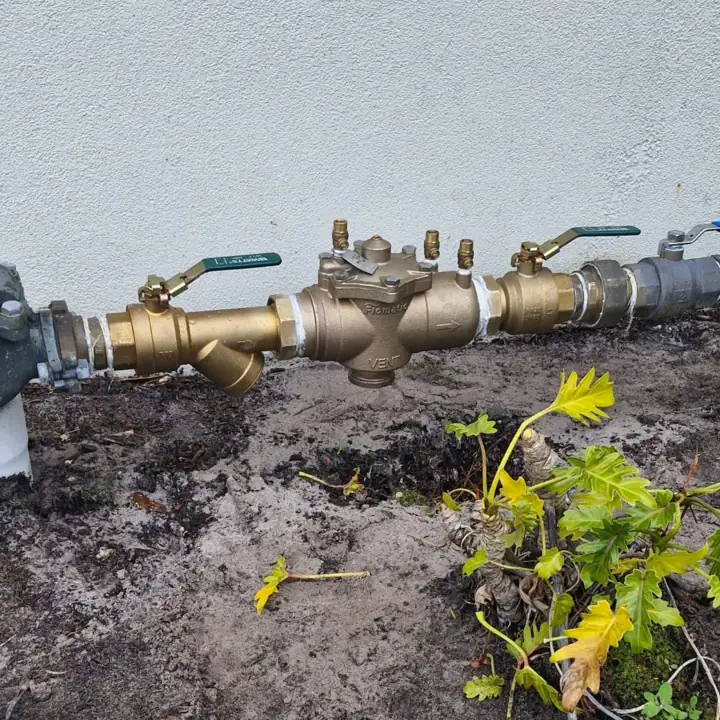
Where a backflow device sits on your water service
Water is meant to run one way: from the main in the street, through your meter and into the property. Backflow is that water running back the other way. It happens when pressure in the main drops, say from a burst or heavy draw nearby, or when something on your side pushes harder than the main, like a pump or a boosted fire service.
Whatever the water has been sitting in comes back with it: stale water from fire pipework, fertiliser from an irrigation line, tank water, or chemicals from a business process. A backflow prevention device lets water in and closes against anything trying to come back out.
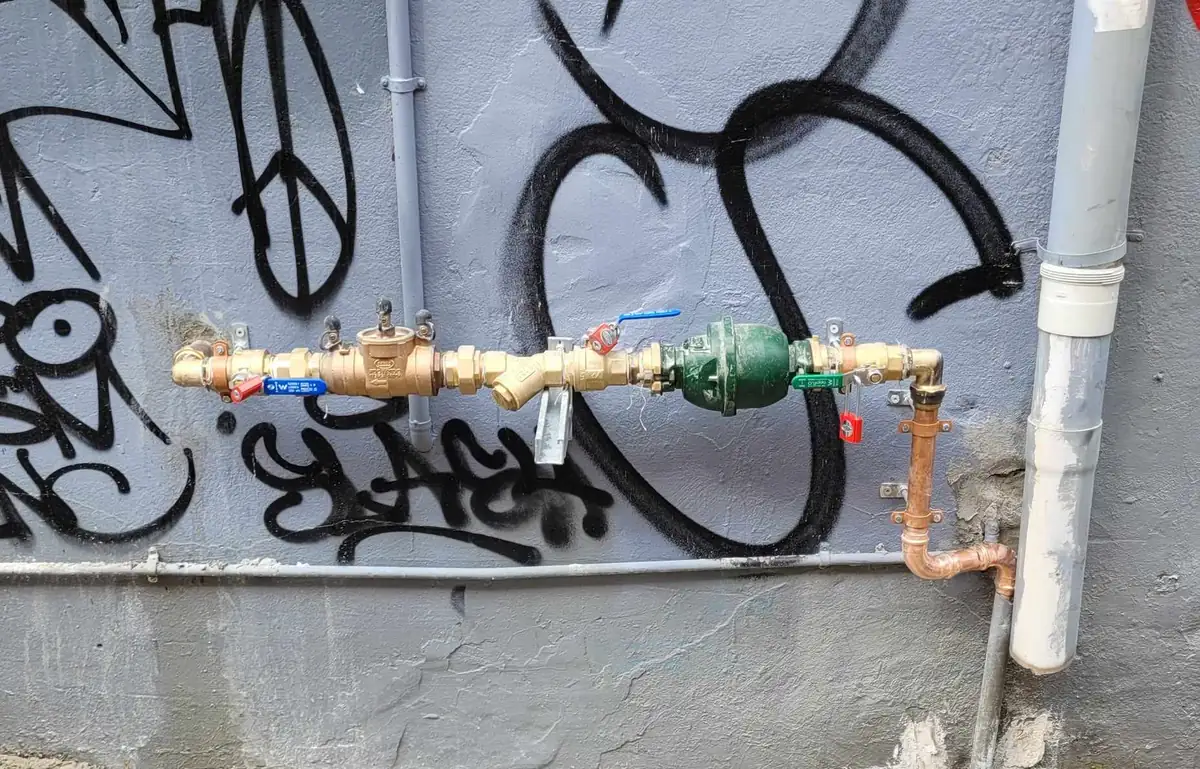
The device goes straight after the water meter, at the property boundary. From the device onwards the property owner is responsible for installing it, keeping it working and having it tested.
Low, medium and high hazard, and the device each needs
Hunter Water rates every connected property by what could get into the water, and the rating sets the minimum device.
Which rating your property falls under
| Property or use | Rating | Minimum device |
|---|---|---|
| Houses | ||
| House on a 20 or 25 mm Hunter Water meter, nothing else connected | Low | Dual check valve, inside the meter |
| House with an above-ground rainwater tank | Low | Dual check valve |
| House with a below-ground rainwater tank | Medium | Testable double check valve |
| House using bore water or reclaimed stormwater | Medium | Testable double check valve |
| Strata and businesses | ||
| Any property on a 32 mm meter or larger | Medium | Testable double check valve |
| Strata of 3 or more units with pop-up irrigation or an above-ground tank | Medium | Testable double check valve |
| Food and drink processing, grease or silt traps, spas and fountains, mixed-use office buildings | Medium | Testable double check valve |
| Commercial laundries, irrigation with fertiliser injection, building sites for 3 or more units | High | Reduced pressure zone device |
| Fire services | ||
| Commercial or industrial building with sprinklers, hydrants or hose reels | Medium | Testable double check valve |
| Hydrant or sprinkler service with chemical injection, or in a high hazard area; existing below-ground hydrants | High | Reduced pressure zone device |
From Hunter Water's Site Containment Backflow Prevention standard, version 3, October 2023. Hunter Water can raise a property's rating on review, and a site with more than one use takes the highest.
Backflow on fire services
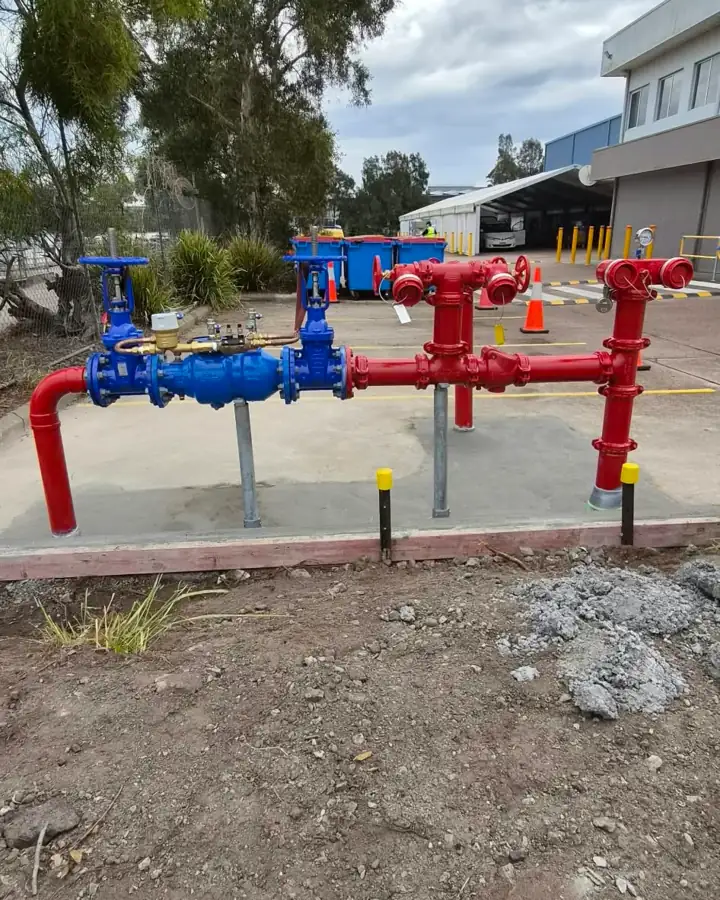
A hydrant or sprinkler service holds water in its pipework for months between tests. That water has to stay out of the drinking supply, so the fire service gets its own backflow valve set on the connection, like the blue valves ahead of the red pipework in this photo.
We do hydrant installs and alterations, annual hydrant and sprinkler inspections, and backflow testing and installs. That means the valve set on your fire service and the system behind it can be looked after by the one business, on commercial and strata sites.
What the yearly test involves
Check the device and where it sits
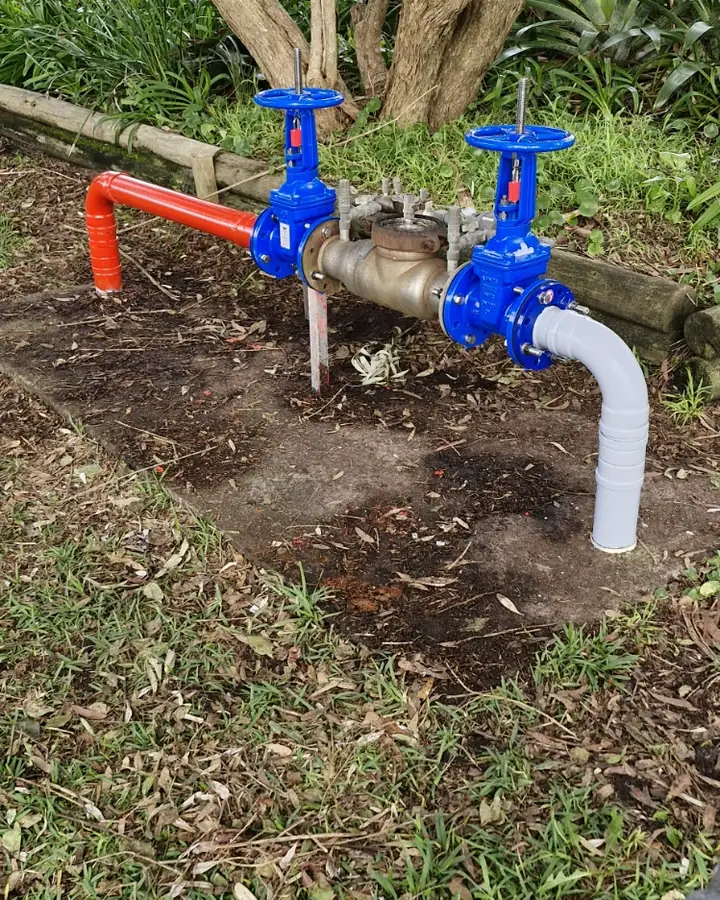
The valves, strainer and fittings are looked over for leaks and damage, and the device has to be above ground where it can be reached.
Isolate it and connect the test kit
The isolating valves close and a differential pressure gauge goes on the test points. Water to the property is usually off for this part.
Test each valve
Each check valve has to hold against water pushing the wrong way. On a reduced pressure zone device, the relief valve also has to open at the right point.
Put right what fails
A valve that leaks or sticks is serviced or replaced, then tested again.
Lodge the result
The result goes to the water authority: Hunter Water through its online backflow app, MidCoast Council, which sets its own deadline for the owner, or Central Coast Council through its own online form. A new device is tested the same way, and Hunter Water wants that first test in within seven days of install.
Backflow testing and installs
- Work
- Testing and installs
- Accredited
- Hunter Water, under Tim's personal plumbing licence 465005C
- Properties
- Homes, strata, businesses, fire services
- Yearly test
- Medium and high hazard devices, required by the water authority
- Emergencies
- 24/7 emergency services
Booking a test? A photo of the device and the meter beside it helps, along with the address and who can let us in.
When a device is missing, failed or overdue
- Water from fire pipework, an irrigation line or a tank can be drawn back into the main that supplies the whole street.
- Hunter Water can issue a notice to repair, test, replace or install a device by a set date, at the owner's cost.
- If the notice is not met, Hunter Water can disconnect the property's water supply until it is.
- MidCoast Council charges extra fees when a test result is not in by the due date.
- A hose or irrigation line run off a device's test tap is not allowed, and Hunter Water disconnects it.
- Hunter Water's standard says a device should not be buried or put in a pit, so an old buried device may need moving.
- When a property's use changes, such as a food business moving in or a tank going in, the device has to suit the new hazard.
Who takes your test result, area by area
| Area | Water authority | From Thornton |
|---|---|---|
| Maitland | Hunter Water | about 15 min |
| Raymond Terrace | Hunter Water | about 15 min |
| Newcastle | Hunter Water | about 30 min |
| Lake Macquarie | Hunter Water | about 35 min to Toronto |
| Tea Gardens | MidCoast Council | about 50 min |
Hunter Water supplies Maitland, Newcastle, Lake Macquarie, Port Stephens, Cessnock, Dungog and small parts of Singleton.
Tea Gardens runs on MidCoast Council's own supply, with its own backflow procedure. Council sends a reminder 30 days before a test is due, charges an annual registration fee for each testable device, and the owner has to get the result to council within 14 working days of the test.
The Central Coast runs on Central Coast Council's own supply. Council takes each device's annual test result through its online Backflow Prevention Device Annual Inspection form.
Further up the Hunter Valley, outside Hunter Water's area, the local council runs the water supply and sets the rules.
Common questions
Does my house need a yearly backflow test?
Most houses don't. On a 20 or 25 mm Hunter Water meter, the low hazard device is built into the meter and isn't tested every year. A house needs its own testable device when something on the property raises the hazard, such as a below-ground rainwater tank, or bore water or reclaimed stormwater in use.
How often does a testable device need testing?
Once when it goes in, then every year for as long as it's there. The seals, springs and moving parts inside wear over time, which is why the test repeats.
Who sends the test result to Hunter Water?
The tester lodges it through Hunter Water's online backflow app. The property owner pays for the test.
Will the water be off while you test?
For part of the test, usually. The device has to be isolated to test it, so let the people in the building know, and tell us if there's a café, surgery or anything else that can't lose water at a certain time.
What happens if our device fails?
It needs servicing or replacing, then a retest. We install backflow devices as well as test them, so the repair or replacement can follow the failed test.
Can I connect a hose or irrigation to the tap on the device?
No. The taps on a backflow device are for testing only. Hunter Water disconnects anything plugged into one, because it bypasses the protection the device is there for.
Our strata building has hydrants and hose reels. Does the fire service need backflow?
Most likely. Hunter Water rates commercial and industrial buildings with sprinklers, hydrants or hose reels at medium hazard or higher, and residential fire services can be rated medium too. Medium means a testable device and a test every year.
The device is leaking. Who do I call?
Us, on 0474 659 574. We're open 24 hours, 7 days. If water is spraying, turn it off at the meter, which sits just before the device.
Related services
Backflow testing across Maitland, Newcastle, Lake Macquarie, Raymond Terrace, Tea Gardens, the Hunter Valley and surrounds. Every photo on this page is from our own jobs.
- Standard: Site Containment Backflow Prevention, version 3, October 2023, Hunter Water.
- Backflow prevention, Hunter Water.
- Device registration and testing, Hunter Water.
- What we do: area of operations, Hunter Water.
- Backflow Prevention Procedure, MidCoast Council.
- Backflow Prevention Device Annual Inspection, Central Coast Council.