
Hydrostatic pressure testing for fire hydrant systems, Maitland to Newcastle
We hold your pipework at the test pressure written on its booster board, then look for anything that leaks.
For builders finishing a new install or alteration, and for owners, strata and facility managers looking after an existing system, across Maitland, Newcastle, Lake Macquarie and the Hunter.
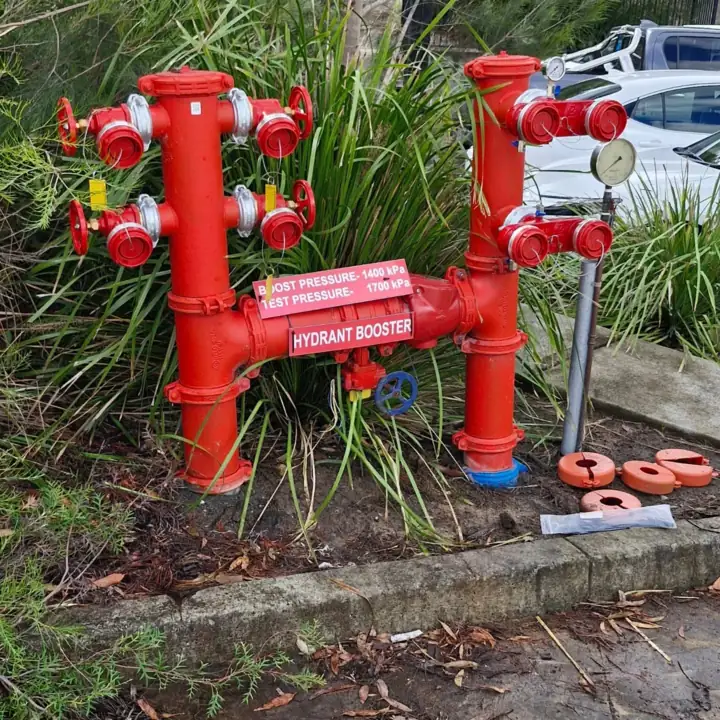
Two pressures on the booster board
The board at your hydrant booster shows two figures. The boost pressure is what the system is set up to take when the fire brigade pumps water in through the booster. The test pressure is the higher one: the pressure the pipework is tested to hold. A hydrostatic test takes the system up to that second figure.
| Booster | Boost | Test |
|---|---|---|
| In a garden bed | 1400 kPa | 1700 kPa |
| Beside a steel fence | 700 kPa | 1700 kPa |
Both boards give 1700 kPa for the test, while their boost figures are a long way apart. Each system carries its own numbers, so we test to the one on your board rather than a figure carried from the last job.
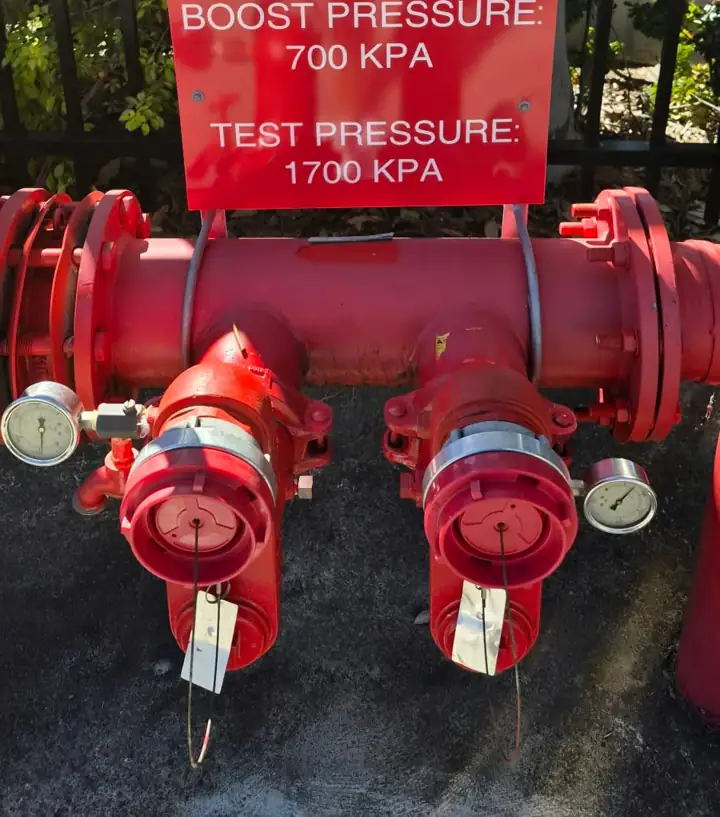
How the test runs
Read the board and isolate
We note the test pressure from the boost and test pressure sign and close the valves that separate the section under test from its water supply.
Fill and bleed the air
The pipework is filled with water and the air let out at the high points. Trapped air squeezes under pressure and can hide a slow leak.
Pump up to test pressure
A test pump brings the pressure up gradually to the figure on the board, with a gauge on the line.
Hold it and watch the gauge
The pump is shut off and the system sits at test pressure for the hold period. A needle that falls means water is getting out somewhere.
Walk every joint
While it holds, we check flanges, valves, the booster inlets and any exposed pipe for drips or weeping.
Let it down and record
The pressure comes off slowly, valves go back to their normal positions, and we record what held and anything that leaked.
Hydrostatic pressure testing
- Held at
- The test pressure on your boost and test pressure sign
- Suits
- New installs, alterations, repairs and existing systems
- Buildings
- Commercial and strata
- Emergencies
- 24/7 emergency services
What the gauge should do
A flat line at test pressure means the pipework held. A line that drifts down means a leak to find and fix.
What gets held at pressure
The test covers the pipework the fire brigade relies on, from the booster inlets to the last hydrant outlet.
The booster assembly
The inlets the brigade connects to, the valves and gauges beside them, and the pipe that carries water from the booster into the system.
Underground mains and hydrants
The buried main feeding hydrants on posts and pads around the site. A leak underground may never show at the surface, which is why the gauge matters.
Risers and landing valves
The vertical pipes inside a building and the hydrant valves on its floors. A weeping joint here can put water through the building.
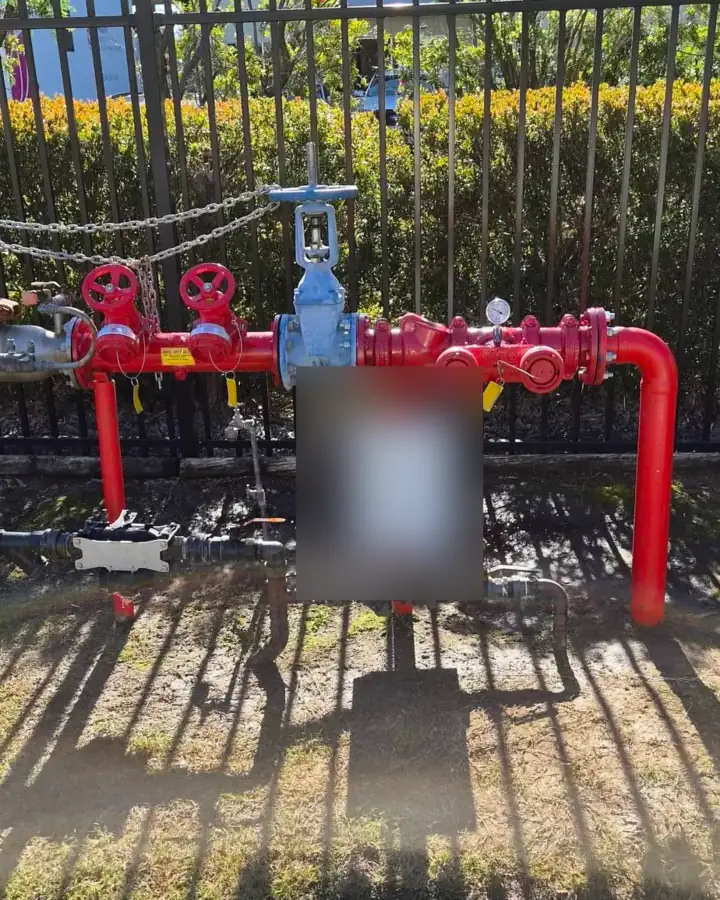
Building a system, or looking after one
New installs and alterations
Book the test while the pipework is still in view: before a trench is backfilled, a wall is lined or a ceiling goes up. A leak found then is a joint to remake, not a slab or a wall to open.
- New hydrant systems, alongside our AS 2419.1 commission testing
- Extensions where new pipe joins an existing main
- Commercial fit off alterations
Existing systems
For owners, strata and facility managers, a pressure test answers one question: does the pipework still hold the figure on its board?
- After a valve, hydrant or section of main has been repaired or replaced
- When there are signs of a leak, such as damp ground over a buried main or a drip at a flange
- When a service or inspection report calls for one
A joint that weeps at test pressure will also weep when the fire brigade pumps into the booster. The test is the time to find it.
Common questions
Is a hydrostatic test the same as a flow test?
No. A flow test opens a hydrant or the booster and measures pressure and flow with water moving. A hydrostatic test keeps the water still, holds the pipework at its test pressure and watches for any loss. We do both: see hydrant flow testing and pump assisted booster flow testing.
What pressure do you test to?
The test pressure on the boost and test pressure sign at your booster. If the sign is missing, faded or no longer matches the system, mention it when you book. We also do block plans and compliance signs.
Can the test cause a leak?
The system only goes to its own test pressure, the figure its pipework is meant to hold. A joint that lets go at that pressure was already the weak point, and it's better found by us with the supply closed off than by the brigade at a fire.
Is the hydrant system out of action during the test?
The section being tested is closed off from its supply while it's under pressure. When you book, tell us about the building and who needs to know, so the timing can be planned around the site.
When should a builder book the test?
Once the pipework is in and before it's covered, while trenches are open and walls and ceilings are still unlined. A leak is far easier to reach at that stage.
What happens if the pressure drops?
We look for where the water is going and tell you what we find. Repairs fall under our fire hydrant installs and alterations work, and the section can be tested again once it's fixed.
Do you come to my area?
We work across Newcastle, Lake Macquarie, the Central Coast, Maitland, the Hunter Valley, Port Stephens, the Mid Coast and surrounding areas, from our base in Thornton. For a leak that can't wait, we offer 24/7 emergency services on 0474 659 574.
Related fire services
We pressure test hydrant systems in Maitland, Newcastle, Lake Macquarie, Raymond Terrace, Tea Gardens and the Hunter Valley.