Pump assisted booster flow testing across the Hunter
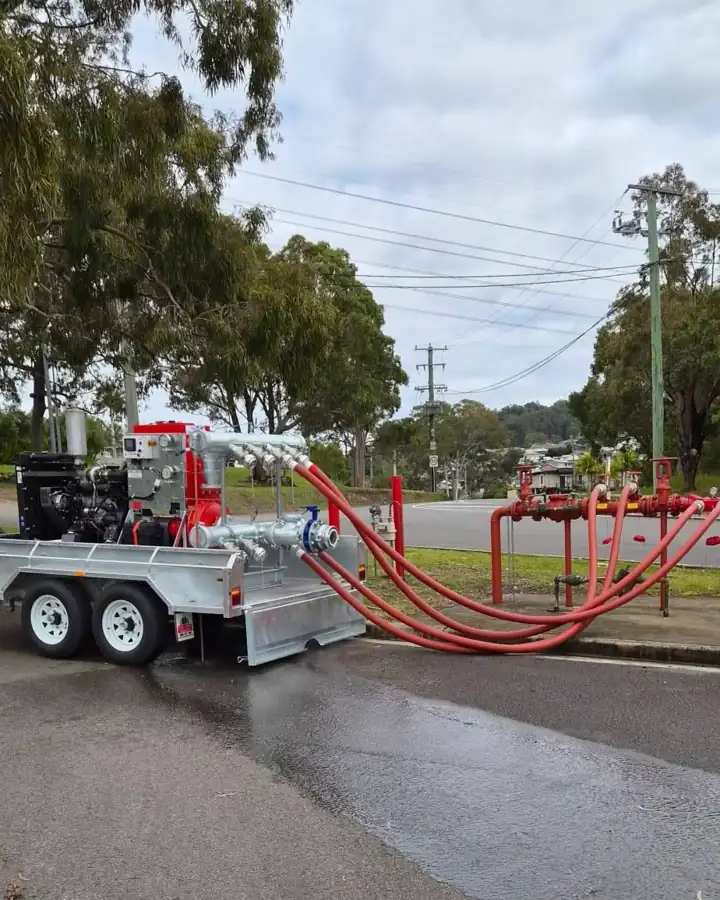
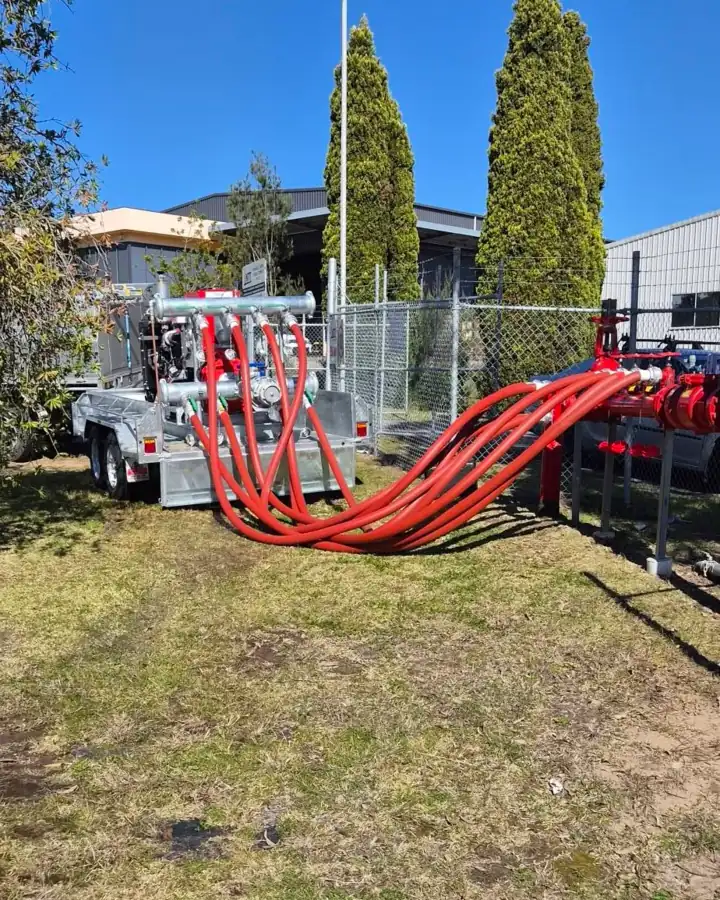
We bring our own pump to your booster and push water in through it, the way a fire truck would at a fire.
AS 1851 pump assisted booster flow testing for commercial and strata buildings across Maitland, Newcastle, Lake Macquarie, Raymond Terrace and Tea Gardens.
Call 0474 659 574 Book a booster test
- Our own pump trailer and hoses
- Open 24 hours, 7 days
- 5.0 on Google from 37 reviews (September 2026)
What a hydrant booster is for
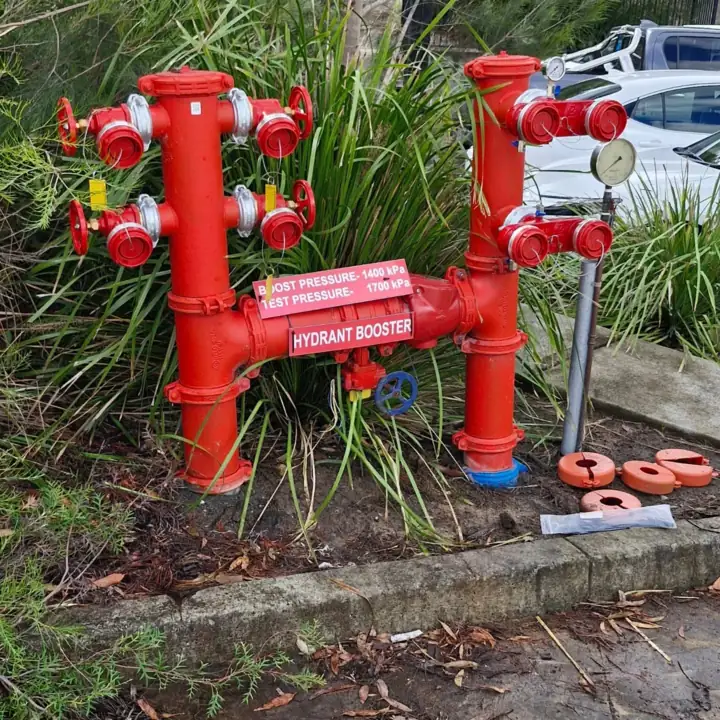
The booster is where the fire brigade connects at a fire. Their truck pumps into the booster inlets, and the water is pushed up the building's hydrant pipework to the hydrants the firefighters are working from. It's there for when the water supply alone can't give the hydrants enough pressure or flow.
Each booster carries its own numbers. The sign on this one gives a boost pressure of 1400 kPa, the most the brigade should pump into the system, and a test pressure of 1700 kPa, the pressure its pipework was tested to.
A hydrant flow test runs on the supply you already have. The pump assisted booster test is the one that shows the inlets, valves and pipework can carry pumped water through to the hydrants.
How the water moves during the test
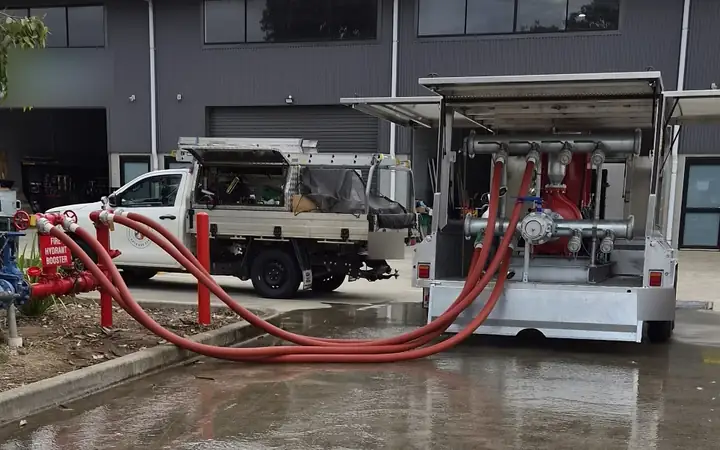
Our pump stands in for the fire truck. Everything after it is your building's own system.
-
Water supply
The water for the test comes from the site's own supply.
-
Our pump
The pump on our trailer takes the place of the fire truck.
-
Booster inlets
Hoses run from the pump's manifold to the booster inlets.
-
Hydrant pipework
The pumped water travels through the system's valves and pipes.
-
Hydrants flowing
Water runs out at the hydrants being tested, where pressure and flow are read.
What the booster flow test involves
Check the booster first
The inlets, caps and valves, the sign and block plan, and any damage or leaks, all before the pump starts.
Set up the rig
The trailer parks beside the booster and hoses run from the pump to the inlets. Test gear goes on at the hydrants, with the discharge aimed where it can drain away.
Pump and flow
The pump pushes water in through the booster while the chosen hydrants are opened. The pump is kept within the boost pressure on the sign.
Read the gauges
Pressure at the booster, and pressure and flow at the hydrants, are read with water moving and checked against the numbers the system was built to deliver.
Pack down and record
Pump off, hoses drained and rolled up, caps back on the inlets, and the results recorded.
Pump assisted booster flow test
- Standard
- AS 1851-2012
- Equipment
- Our own pump trailer and hoses
- Buildings
- Commercial and strata
- Emergencies
- 24/7 emergency services
When the test finds a problem
A fault found on a test day can be fixed before anyone has to rely on the booster.
A leak under pressure
A weep at a joint or an inlet can show up once pumped water is behind it. A hydrostatic pressure test holds the system at its test pressure to find where.
Hydrostatic pressure testingA part that needs replacing
A damaged fitting, a missing cap or a valve that won't do its job on the booster. We do fire hydrant installs and alterations.
Hydrant installs and alterationsLow pressure or flow
If the hydrants fall short with the pump running, the cause could be in the pipework, the valves or the building's own fire pump set. We maintain and install fire pump sets.
Ask about pump setsIn NSW, a building's annual fire safety statement covers each fire safety measure on its fire safety schedule, with each one assessed by an accredited practitioner (fire safety). The hydrant system, booster included, is usually one of them, so testing well before the statement is due leaves time for repairs.
Getting the site ready
The rig needs room at the booster and the water needs somewhere to go. When you book, tell us about:
- Access to the booster: gate keys or codes, and space for the trailer beside it
- Cars kept off the kerb if the booster is on the street
- Access to the hydrants being flowed, outside and inside
- Where the water can run off, and any drains or low spots nearby
- Tenants or residents who should know hoses will be out and water running
- The last test records, if you have them
Common questions
How often does a booster need a flow test?
That depends on your building. Its fire safety schedule and maintenance records set out what's due, so send us the date of the last booster test with your enquiry and we'll book the next one from there.
Why use a pump instead of mains pressure?
The booster is built to take pumped water from a fire truck. Testing it on mains pressure alone doesn't show how it copes with water being pushed in, so our pump does that part of the brigade's job for the test.
Do you need to park right at the booster?
The trailer has to be close enough for the hoses to reach the inlets. At a street-side booster that means a clear stretch of kerb. On a site, it means a clear way in to the booster.
Where does the water end up?
It comes out at the hydrants being flowed, so it needs a path to a drain or open ground that won't flood a car park or the building next door. Point out any trouble spots when you book.
Is a booster the same as a fire pump set?
No. The booster is the connection for the brigade's pump. Some buildings also have their own fire pump set on the hydrant system, and we do fire pump set maintenance and installs as well.
Do you test boosters on strata buildings?
Yes. We work on commercial and strata buildings, including the booster and the rest of the hydrant system.
What if a fault can't wait for a booking?
Ring 0474 659 574 rather than booking online. We're open 24 hours, 7 days, and a damaged booster is one of the faults on our emergency page.
Other work on the hydrant system
We test boosters in Maitland, Newcastle, Lake Macquarie, Raymond Terrace, Tea Gardens and the Hunter Valley, from our base in Thornton.
- AS 1851-2012, Routine service of fire protection systems and equipment, Standards Australia.
- AS 1851-2012 in NSW, NSW Government Building Commission.
- Fire safety certification and annual fire safety statements, NSW Department of Planning.